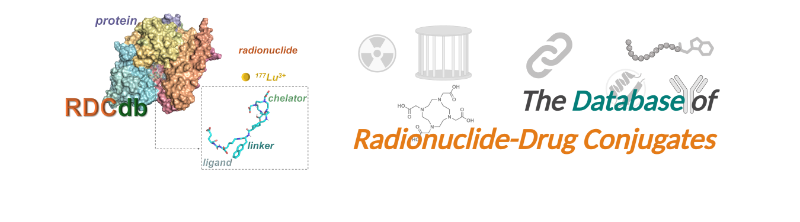
About RDCdb
RDCdb, a novel drug database, has been created to deliver comprehensive drug information from multiple perspectives, especially pharmaceutical details and biological activities. Particularly, a total of 2053 RDCs (A total of 229 candidates have been approved by the FDA or are currently in the clinical trial pipeline, while 1824 RDCs have undergone preclinical evaluation with available in vitro and/or in vivo experimental data), together with their explicit pharma-information was collected and provided. Moreover, a total of 1492 literature-reported activities were discovered, which were identified from diverse clinical trial pipelines, cell lines and animal models, etc. Despite their considerable advantages, no existing database is specifically dedicated to the systematic description of the biological activities and comprehensive biological activity and pharma-information of RDCs, and a comprehensive database specifically tailored to curate such data is highly warranted.
RDCs consist of several key components: Ligand, Radionuclide, Chelator, Linker, and Cold compound. Below is a brief introduction to each component:
Ligand
The targeting ligand in RDCs serves as the crucial mediator for accurately delivering radionuclides to targets on cancer cells or other target cells through vectors including small molecules, peptides and antibodies (Sig Transduct Target Ther 10, 1, 2025).
An ideal ligand should possess suitable binding affinity and specificity for the intended target. Furthermore, this moiety should also exhibit a plasma half-life compatible with the radionuclide, thereby maximizing therapeutic efficacy while minimizing potential off-target uptake and hematotoxicity.
Radionuclide
Radionuclides, the core of RDCs, are categorized as diagnostic or therapeutic. With PET/SPECT, diagnostic radionuclides enable rapid, precise whole-body lesion monitoring and noninvasive, quantitative, real-time target-expression assessment. Therapeutic radionuclides, via radiation energy, induce DNA single- or double-strand breaks that lead to cell death. (Theranostics 11, 7911-7947, 2021).
Chelator
In RDCs, the chelator serves as the linker between the radionuclide and the functional ligand, primarily functioning to sequester the radionuclide and prevent its leakage. An ideal chelator exhibits strong coordination ability as well as high kinetic and thermodynamic stability (Biomedicine & Pharmacotherapy, Volume 165, 2023).
Currently, an increasing number of chelators with more novel structures — based on both macrocyclic and acyclic chelating agents — are being developed, which can effectively enhance chelation efficiency and ensure thermodynamic stability within the complexes (Inorg. Chem. 62, 20549-20566, 2023).
Linker
The selection of an appropriate linker—responsible for bridging the ligand and the chelator—is critical in RDC design, as it improves in vivo stability (reducing hematological toxicity and radiolytic degradation). Numerous studies have demonstrated that linker modification can further refine pharmacokinetic profiles, including biodistribution, tumor uptake, and tumor-to-background ratio. Linkers used in RDC development can be broadly categorized into functional amino acid linkers, linkers conjugated with albumin-binding moieties, hydrophilic linkers, and flexible PEG-based linkers, etc. (Seminars in Nuclear Medicine, 49, 5, 339-356, 2019).
Cold compound
A cold compound is defined as a non-radiolabeled compound. A given chemical structure can be labeled with different radionuclides, thereby enabling theranostic pairing. Labeling an identical cold compound with distinct radionuclides elicits different biological behaviors—including variations in chelation stability and in vivo pharmacokinetics—highlighting the importance of matching the radionuclide to the chemical structure (Theranostics, 12 (1), 232-259, 2022).
Biodistribution
In contrast to conventional biologics, greater emphasis is placed on tumor uptake and off-target accumulation in radionuclide drug conjugates (RDCs), and structural optimization is employed to suppress off-target uptake and thereby reduce off-target toxicity (Nature 630, 206-213, 2024). Small-molecule ligand-based RDCs exhibit limited tumor retention owing to their rapid metabolic clearance, which compromises therapeutic efficacy. Antibody-based RDCs, by virtue of the prolonged circulation half-life of the antibody, frequently induce hematological toxicity and high background signals. Peptide-based RDCs, conversely, demonstrate marked accumulation in metabolic organs—particularly the kidneys—due to renal processing, substantially restricting in vivo investigations. To date, numerous strategies have been devised to modulate the absorption, distribution, metabolism, and excretion (ADME) profiles of RDCs, such as extending tumor residence time, fine-tuning the half-life, and accelerating renal clearance. Collectively, these approaches can effectively enhance tumor uptake and retention, increase the tumor-to-background ratio, and reduce RDC accumulation in non-target metabolic organs.
Mechanism of action
RDCs permit precise, ligand-mediated delivery of radionuclides to targets that are selectively expressed on the surface of cancer cells. Upon target binding, therapeutic RDCs (β- and α-emitters) elicit direct cell death via radiation-induced single- or double-stranded DNA breaks, base damage, and crosslinks. Besides, this emerging clinical cancer therapy integrates intrinsic theranostic capabilities with a "crossfire" mechanism—killing cancer cells even without direct targeting—and functions independently of the biological routes used for binding targets (Nat. Rev. Drug Discov. 19, 589-608, 2020). Diagnostic RDCs (γ-emitters), when paired with positron emission tomography (PET) or single-photon emission computed tomography (SPECT), enable non-invasive, quantitative, real-time evaluation of target expression in lesions (Nat. Med. 28, 606-608, 2022).